Monday, 26 October 2020

History of Sikkim - 3

Today's the last day when we will be discussing the prehistoric period of Sikkim's past. After this will be continuing with Sikkim's history under monarchs. So without any further ado let's begin.


Apart from the Lepchas, the Limbus were also ruling a part of Sikkim in the west, before the supremacy of Tibetans over the land of Sikkim was established. The Limbu is a tribe that is equally found in Eastern Nepal and Sikkim. According to their old traditions, which they call Mundhum,
Limbu people - Wikipedia
Limbu people
it is said that when the pioneer Lamas of Tibet visited Sikkim, for the first time, a tribe who revered the Kalog Lama as their Guru, followed him from Tsang province of Tibet. But, the Gorkhas call them Limbus. They first settle down on the banks of the Arun River, right down to Kankai.

Saturday, 24 October 2020

History of Sikkim - 2

 Today we will be continuing our tour to Sikkim's royal and mystic past. Let's begin


The consultation of the Mun Boongthing (the Lepcha Priest) reflects that the Lepchas are the most primitive and autochthons race of Sikkim. It is presumed that more than 3000 B.C. the Lepchas had installed the “stairway to heaven” of clay pot at present day’s Daramdin in west Sikkim. During the ascendancy of the Lepchas, Sikkim was known as “Mayal- Lyang” or the land of hidden treasures.
1
Traditional Lepcha couple
The geographical extent of Sikkim under Lepcha sovereignty was widely extended. It is been assumed that the region of
present-day Nepal and Bhutan was the part of Sikkim and in the south, it was flourished till Malda in present West Bengal. Further, the Chumbi valley of Tibet was also a part of ancient Sikkim. The original inhabitants of Chumbi valley in Tibet were also the Lepchas. Heybum Panu or Dungpemsar was the chieftain and his capital was at Chumbi. Meanwhile, the struggle between the followers of ‘Red Hats’ and the ‘Yellow Hats’ of Buddhism in Tibet forced the Lepchas of Chumbi to take refuge in Sikkim and other places. The Limbuwana, which was known to the Nepalese as Pallo Kirat (far away Kirat), was also a part of ancient Sikkim.


Friday, 23 October 2020

History of Sikkim

Today we will discuss History of Sikkim but will be covering only the prehistoric period! We will be talking about Sikkim's history for the days ahead learning more about how it's unique culture came into existence. So let's begin!


Pre-History

The legendary account of the Pre- Historic Sikkim reveals that there were no establishments of settled governments. Several small rulers or more appropriately the chiefs were ruling over these areas in different period of time. By around 4,000 B.C. the Neolithic human developed the art of land cultivation due to scarcity of available food. Agriculture required people to stay in one spot and so fixed settlement emerged. According to the legend of the Kiratas, the black soybean was the first crop, domesticated and cultivated by the Kiratas in this part of the country. The lone cultivated crop was thus eaten in different ways to avoid monotonousness of eating.
SHUBHAKAMANA NEPAL: Introduction of Nepales cast KIRATAS IS Eastern part of  Nepal
A traditional Kirata


किरातार्जुनीयम् - विकिपीडिया
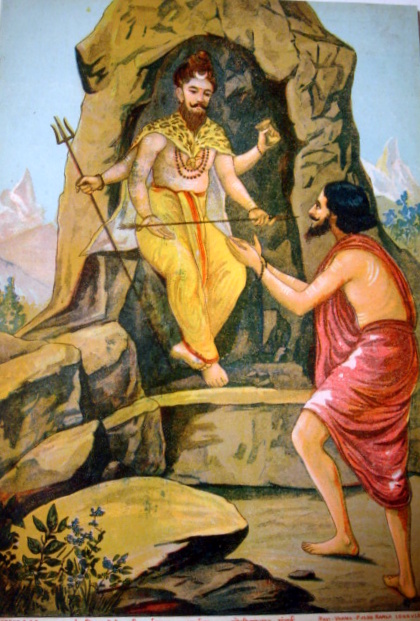
Lord Shiva giving Arjun the Pashupaat Astra


Did You know? The native people of Sikkim are mentioned in the Mahabharata as Kritas(Hunters). They worship Lord Shiva as Kirateshwar Mahadev(God of the kritas) and believe him to be their first king. It is believed that Lord Shiva once appeared as a hunter to test Arjun's warfare. He challenged Arjun for a duel, in which Arjun was defeated but still admiring his strength Lord Shiva gave him The Pashupaat Astra. This whole incident took place at the very spot at the present-day Kirateshwar Mahadev Temple in Lyuksyep, Sikkim.


Phew! That's all for today. Hope you didn't get bored. We will discuss Sikkim's history further tomorrow. Tell me in the comments if you liked this or not and what I need to improve. Constructive criticism is welcomed. Have a great day!


History of Sikkim - 3

Today's the last day when we will be discussing the prehistoric period of Sikkim's past. After this will be continuing with Sikkim...